JoAnn Stevelos~Plays
LITTLE RED WAGON
by JoAnn Elizabeth Stevelos
A play about a family that waited 20 years to open a letter.
SYNOPSIS
Little Red Wagon is a three-act play about a family that has created a temporal divide from a political activist’s death by suicide to the present and explores the layers of grief that tether the family to one another in conspiratorial silence.
In Act One, Ezra and Walter are raising Lucy together. When Lucy turns twenty, she expects to read a posthumous letter written to her by her mother, Attie. Yumi, a barista in the café and Walter’s secret love interest, encourages Walter and Ezra to give Lucy the letter. Ezra and Walter ultimately give Lucy the letter but are surprised by her reaction. Ezra and Walter worry about Lucy’s growing interest in activism.
In Act Two, Lucy follows in her mother’s footsteps and joins an Antifa group. Ezra has passed away and Yumi has left Walter. Walter struggles to support Lucy’s activism and her resistance to motherhood, all the while caring for Shanti, Lucy’s daughter. Lucy’s and her partner, Christo, organize an Antifa rally in South Carolina. Lucy is arrested. The political climate is violent and chaotic. Christo persuades Lucy to leave America and go to Kosovo. Lucy wants Walter to come with them.
In Act Three, Walter, Lucy, Shanti, and Christo go to the airport to fly to Kosovo. Walter forgets his passport and must return home. Lucy realizes Walter does not want to leave and has decided to stay. Walter, unlike Lucy and Christo, believes American democracy is not dead. Walter returns to the café. The ghost of Ezra is there to greet him. During the final scene the café goes through rapid changes as the lights flash on and off. Customers come and go. Yumi returns. Lucy, Christo, and Shanti visit. Walter and Yumi age. The final flash of light shows a For Sale sign in the café window.
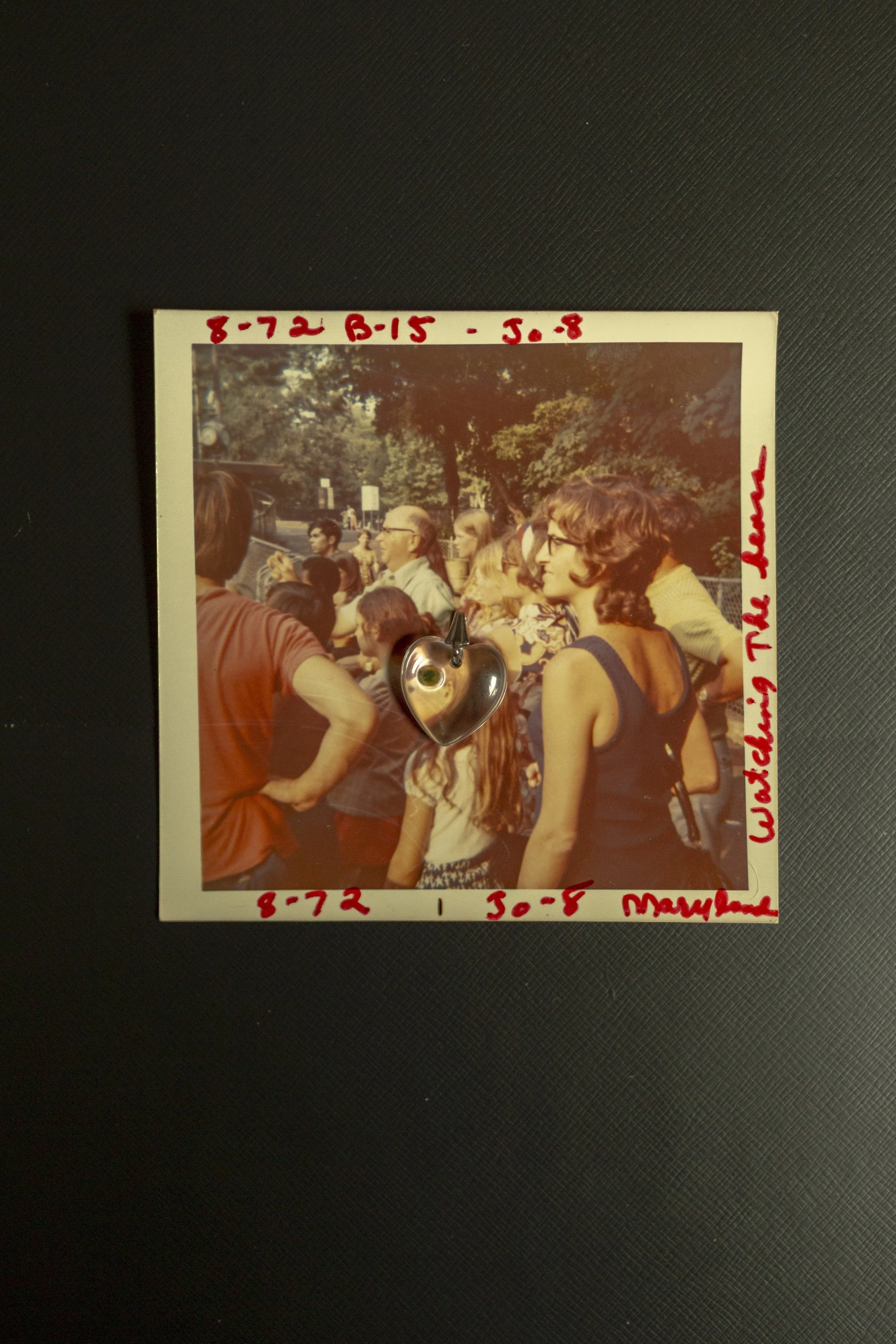
Photo by Sarah Blesener
BOX OF LIGHT
A One-Act Play
by JoAnn Elizabeth Stevelos
SYNOPSIS
Box of Light is an experimental one-act play about family archives, child sexual abuse, institutional betrayal, and the unstable nature of photographic truth. Structured through memory, projection, repetition, and live image-making, the play follows JO, a survivor who inherits her mother’s meticulously curated photo albums documenting the family life she shared with a Catholic priest who abused the children in the household, and SARAH, a visual journalist and collaborator helping her examine the archive.
As the two women sift through photographs, legal files, altered images, and withheld evidence, the play explores how images can simultaneously conceal violence and preserve traces of it. Family snapshots, apology notes, manipulated portraits, and missing photographs become part of an evolving inquiry into memory, authorship, care, and the ethics of representation. Through projections, live photography, sound, and ritualized performance, Box of Light investigates what it means to inherit difficult images and to decide whether they should be preserved, altered, withheld, or destroyed.
Rejecting naturalism and sentimentality, the play treats the archive as a living, unstable space where documentation, memory, performance, and emotional truth continually shift against one another. At its center is a question with no fixed answer: What do we do with photographs of monsters?